
Expertise from local research partners – German Aerospace Centre (DLR) – Institute of Test and Simulation for Gas Turbines (SG)
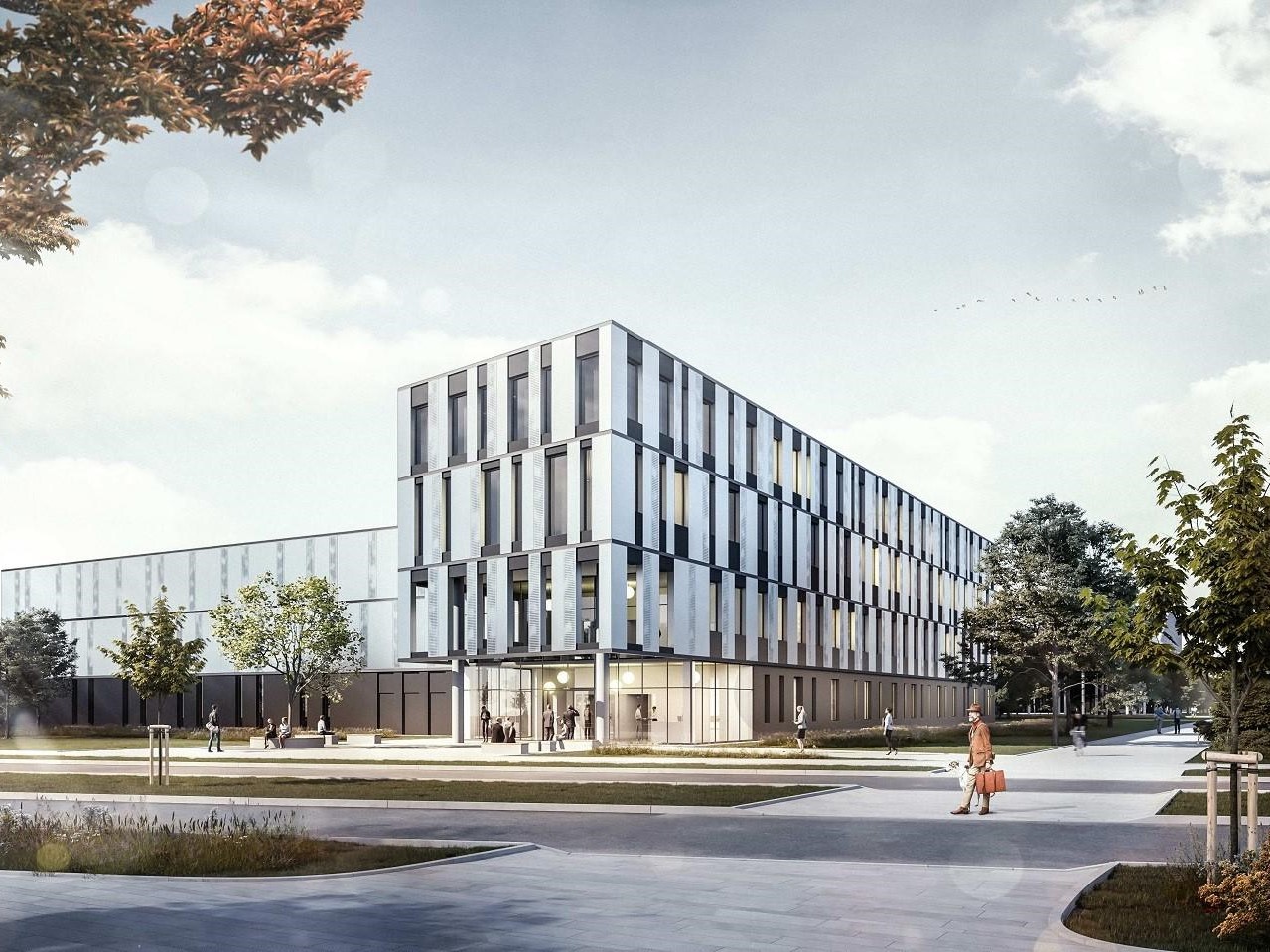
The Institute of Test and Simulation for Gas Turbines conducts research into new engine technologies by combining numerical and experimental methods to validate innovative solutions. The technical challenges involved include high rotational speeds, high temperatures, high pressure ratios and the associated complex load patterns on engine components, coupled with increased service life requirements.
Digital models of new solutions for compressor and turbine components are experimentally validated within the power and scale ranges relevant to engine operation. Using a unique test rig – the first of its kind to allow mechanical, thermal and chemical (exhaust gas) loads to be superimposed on turbine components – tests are carried out to determine whether new materials or manufacturing processes (e.g. additive manufacturing) meet the increased service life requirements. The aim is to experimentally validate new scale-resolving numerical methods that can be used to calculate and optimise the service life and reliability of sophisticated, heavily loaded components and materials (e.g. fibre-reinforced ceramics).
Departments
- Information Technology: The Information Technology Department deals with data management, which is of great importance both for research into virtual engines and for the conduct of experiments. Large and heterogeneous volumes of data are generated, which must be recorded, stored, processed and analysed in a non-hierarchical data management system.
- Virtual Engine and Numerical Methods: The Virtual Engine and Numerical Methods Department is dedicated to the development of new numerical methods for the analysis of heavily loaded engine components. This includes both scale-resolving CFD simulations and the development of a multi-scale, multi-physics structural mechanics code for calculating service life. These methods, along with others available at DLR, are to be integrated into a single platform so that conclusions regarding service life can be drawn using a virtual engine.
- Test Operations and Measurement Methods: The Test Operations and Measurement Methods Department is responsible for both conducting experiments on innovative test machines and for the numerical modelling of these tests. The test machines are capable of testing specimens and real components under pressure and mechanical, thermal and corrosive loads. At the same time, all experiments are modelled in a digital twin in order to simulate and validate material behaviour whilst the tests are still in progress. Further insights are gained from the metallographic examination of the specimens.
The Institute of Test and Simulation for Gas Turbines conducts research into new engine technologies by combining numerical and experimental methods to validate innovative solutions. The technical challenges involved include high rotational speeds, high temperatures, high pressure ratios and the associated complex load patterns on engine components, coupled with increased service life requirements.
Digital models of new solutions for compressor and turbine components are experimentally validated within the power and scale ranges relevant to engine operation. Using a unique test rig – the first of its kind to allow mechanical, thermal and chemical (exhaust gas) loads to be superimposed on turbine components – tests are carried out to determine whether new materials or manufacturing processes (e.g. additive manufacturing) meet the increased service life requirements. The aim is to experimentally validate new scale-resolving numerical methods that can be used to calculate and optimise the service life and reliability of sophisticated, heavily loaded components and materials (e.g. fibre-reinforced ceramics).
Departments
- Information Technology: The Information Technology Department deals with data management, which is of great importance both for research into virtual engines and for the conduct of experiments. Large and heterogeneous volumes of data are generated, which must be recorded, stored, processed and analysed in a non-hierarchical data management system.
- Virtual Engine and Numerical Methods: The Virtual Engine and Numerical Methods Department is dedicated to the development of new numerical methods for the analysis of heavily loaded engine components. This includes both scale-resolving CFD simulations and the development of a multi-scale, multi-physics structural mechanics code for calculating service life. These methods, along with others available at DLR, are to be integrated into a single platform so that conclusions regarding service life can be drawn using a virtual engine.
- Test Operations and Measurement Methods: The Test Operations and Measurement Methods Department is responsible for both conducting experiments on innovative test machines and for the numerical modelling of these tests. The test machines are capable of testing specimens and real components under pressure and mechanical, thermal and corrosive loads. At the same time, all experiments are modelled in a digital twin in order to simulate and validate material behaviour whilst the tests are still in progress. Further insights are gained from the metallographic examination of the specimens.
Core competencies of the DLR Institute of Test and Simulation for Gas Turbines
- Virtual and automated simulation platform for engines and turbomachinery
- Cross-scale simulation of complex aerodynamic flows
- Multiscale simulation for calculating service life, from microstructure to component
- Rotor testing and testing of the secondary air system
- Testing of components and materials under simultaneous mechanical, thermal and chemical-corrosive loads
- Holistic data management based on digitally described ontologies
Contact
German Aerospace Centre (DLR) – Institute of Test and Simulation for Gas Turbines (SG)
Director
Forschungsallee 1
86159 Augsburg
+49 821 319874-1000
contact-dlr@dlr.de
https://www.dlr.de/en/sg